Capital Audio Fest 2025: The Best Sounding Rooms
December 3, 2025
Power: A Vital Foundation for Great Sound
January 29, 2026
Ground: The invisible foundation that determines how much of the music you actually hear.
If I asked you to name the components in your audio system, you’d probably start with speakers, amplifier, source. Maybe cables, if you’ve been down that road. But there’s something more fundamental running underneath everything—something that determines how much of the music actually reaches your ears. And almost nobody talks about it.
Ground. The electrical reference point that every component in your system shares. It sounds technical because it is. But what it does to your listening experience is anything but abstract.
The Problem You’re Not Hearing
Here’s the thing about noise: you don’t hear it as noise. You hear it as absence. A soundstage that should extend beyond the speakers but doesn’t quite. Decay that truncates instead of trailing off naturally. Texture in a voice or a piano that you sense should be there but can’t locate.
This isn’t damage. It’s masking. Electrical signals are always measured relative to something: a zero point that lets your components agree on what the signal actually is. Ground is that shared foundation—the sea level of your electrical system, the baseline that everything is measured from.
But that shared baseline also becomes a pathway. Noise from one component travels to another through the ground they share, and chassis shielding can’t stop it—ground bypasses all of that.
The answer isn’t to eliminate grounding. It’s to keep that shared foundation clean—actively draining contamination rather than just circulating it.
Critical Insight
External electromagnetic fields face substantial barriers reaching your circuits—metal chassis, distance, shielding. But ground connections bypass all of it. They provide direct electrical access to your component’s internals. The very path designed to provide stability becomes a conduit for contamination.
Think of it this way: you can build a house with beautiful windows, but if the foundation settles unevenly, every door will stick. The problem isn’t the doors. The problem is what everything rests on.
What Clean Ground Actually Sounds Like
I’ve introduced dedicated grounding systems to clients who’ve spent tens of thousands on speakers and amplification, and watched their faces when they realize what they’ve been missing. Not a subtle shift. A revelation.
“It’s like opening a window you didn’t know was closed.”
The background drops to genuine black. Not “quiet”—black. And from that blackness, details emerge that were always encoded in the recording but had been obscured. The leading edge of a plucked string. The air around a voice. The sense that instruments occupy distinct positions in three-dimensional space rather than coexisting on a flat plane.
What you’re hearing isn’t added. It’s revealed. The system was always capable of this resolution—the noise floor was simply too high to let it through.
Why This Gets Overlooked
Grounding isn’t glamorous. It doesn’t photograph well. Most dealers don’t understand it well enough to explain it, and manufacturers rarely discuss it because it’s not a sellable feature on the side of a box. So it falls into the category of “advanced tweaks”—something for obsessives to worry about after they’ve already spent serious money on the primary components. That’s backwards.
An Analogy
Imagine hiring an architect to design your dream home, then skipping the foundation work because it’s expensive and nobody sees it. You’d never do that with a house. But audio systems are routinely built this way—premium components floating on compromised electrical ground, never reaching their potential because the reference they share is contaminated.
The right time to address grounding is alongside your first serious power conditioning investment, not years later. If you’ve already invested in clean power delivery—a quality power conditioner, better cables—you’ve addressed half of the equation. But power and ground are two pillars of the same structure. One without the other leaves the system incomplete.
Active vs. Passive: A Real Difference
Not all grounding solutions are created equal. Passive ground systems provide a path—a place for noise to go. Active systems do more: they actively draw contamination out of your components, using specialized filtering and ultra-low frequency biasing to establish a clean reference that the entire system can synchronize to.
The difference in my listening room was immediately audible. The passive approach helped. The active approach transformed.
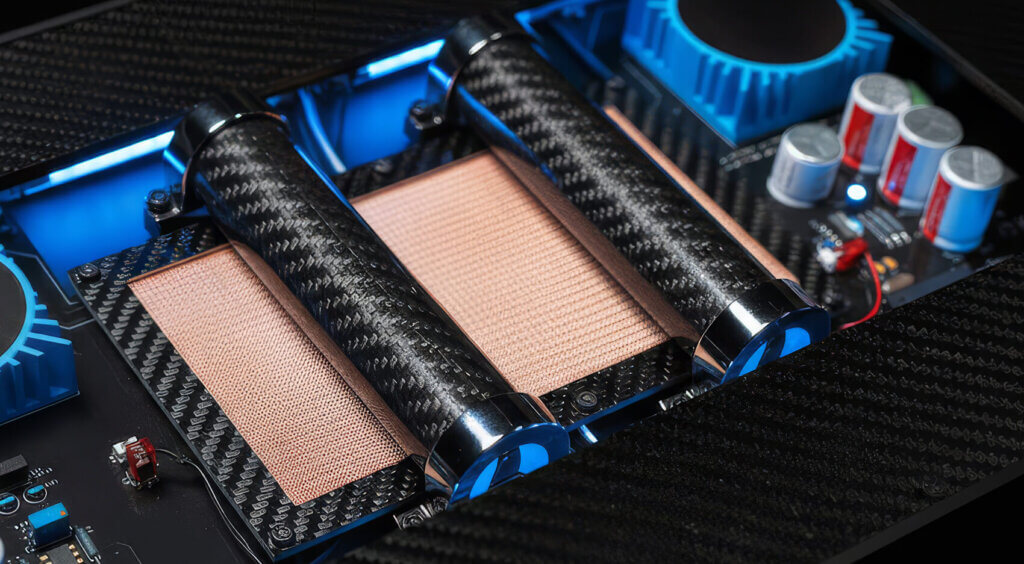
What to listen for: When you add effective grounding, you won’t hear “less noise” directly. You’ll hear more space between notes. More texture in sustained tones. More air around instruments. The music breathes because the system stopped suffocating it.
Where to Start
If your system includes a power conditioner with a dedicated ground plane—and most quality conditioners do—you already have a foundation to build on. The next step is a dedicated grounding system that can extend that reference to every component, every cable shield, every potential noise source in your chain.
Connect your DAC. Your preamp. Your power conditioner itself. If your cables support it, ground those shields too. The more comprehensively you implement grounding, the more cumulative the benefit becomes. This is one of those rare cases where the whole genuinely exceeds the sum of the parts.
I’ve heard systems at every price point. The ones that truly sing share certain qualities: proper power, proper grounding, proper synergy between components. Miss any one of those, and you’re limiting what you paid for everywhere else.
The Bigger Picture
What draws me to grounding as a topic isn’t the technical mechanism—though that’s genuinely elegant once you understand it. It’s what it represents: the parts of audio that matter most are often the parts least discussed.
We obsess over drivers and enclosures, DAC chips and output stages. These matter. But they operate within an environment—electrical, mechanical, acoustic—that shapes everything they produce. Address that environment, and the components you already own reveal capabilities you paid for but never accessed.
Grounding is invisible. So is air around a voice. So is the decay of a piano note trailing into silence. The question is whether you’re hearing what’s actually there—or only what the noise floor permits.
Final Thought
The best upgrades aren’t always the ones that add something new. Sometimes they’re the ones that remove what was blocking what you already have. Grounding is that kind of upgrade—subtractive, invisible, profound.