
Why Grounding Matters More Than You Think
January 15, 2026
You invest in components for the moments they’ll create—the evenings that turn into mornings, the albums that feel new again. The quality of power they receive determines whether those moments arrive or remain just out of reach.
Most system-building conversations start with speakers. Or maybe a dream amplifier. People can spend sizeable amounts of time considering how prospective components may fit into their audio system and whether it will deliver the sound they seek. We think about how the system will look in the room and how it will sound when friends come over. We imagine the listening sessions: the albums we’ll rediscover, the details we’ll finally hear. The equipment gets all the attention. And it should. That’s what makes the music happen.
But here’s a question that rarely gets asked early enough: What’s feeding all of it?
Every component in your system, no matter how refined its circuitry or carefully voiced, is an instrument that plays only as well as the energy it’s given. Even the finest amplifier can’t deliver peak performance without clean and abundant power to fuel it. The most revealing digital music player will have its resolution compromised by contaminated electricity. We invest in components for their potential. The proper power foundation determines whether that potential is realized.
I’ve come to think of it this way: we spend so much time choosing what our systems will say, and almost no time considering whether they have the breath to say it fully.
“It’s like opening a window you didn’t know was closed.”
The Shared Well
Just as people say “you are what you eat”, your audio system can only sound as good as what it’s fed.
Think of your home’s electrical system as a shared well. Every device in your house draws from it. Refrigerators. Dimmers. Computers. HVAC systems. And every one of those devices returns contamination to it: high-frequency electrical noise from digital devices, switching power supplies, and LED drivers; harmonic distortion from dimmers and motors; broadband interference from routers, extenders, and Wi-Fi enabled digital devices.
Your audio components drink from this same well. No matter how refined their internal circuitry, they’re starting with contaminated source material. The amplifier that spent decades in development; the music streamer with advanced clocks and the latest generation chipset. All of them are trying to do their best work with compromised raw materials.
The Hidden Ceiling
Power quality doesn’t add distortion in the traditional sense. It establishes a ceiling on resolution. Everything your system is capable of revealing is limited by the quality of the energy available to reveal it. Remove the contamination, and that ceiling rises. The music was always there; the power was simply preventing you from hearing it.
What Contamination Actually Does
When I talk about power contamination, I’m not speaking in abstractions. These are measurable phenomena with audible consequences:
- Harmonic distortion from non-linear loads like your dimmers, switching power supplies, even LED drivers, creates multiples of the 60 Hz fundamental that ride on top of the power your components receive.
- High-frequency noise in the kilohertz to megahertz range, generated by every digital device in your home, infiltrates through the power lines and couples into sensitive audio circuits.
- RFI and EMI from radio, cellular, and Wi-Fi broadcasts enter through power cables acting as antennas, depositing broadband interference directly into your components.
- Voltage fluctuations (sag when demand spikes, swell when it drops) rob your amplifier of the stable foundation it needs for effortless dynamics.
None of this announces itself with obvious distortion. Instead, you experience the cumulative effect as a subtle veil: slightly closed-in soundstage, transients that lack their full impact, a sense that the music is working harder than it should.
Why Traditional Filtering Falls Short
The conventional approach to power conditioning uses series filtering, which places inductors and capacitors in the signal path to block high-frequency noise. It works, to a point. But there’s a fundamental trade-off: anything in series with the power creates impedance. And impedance limits current delivery.
For audio, this is a problem. Amplifiers need instantaneous access to current during demanding transients, such as the leading edge of a drum strike, the attack of a piano chord, or the dynamic swing from silence to crescendo. When a filter restricts that access, even slightly, you hear it as a subtle compression: dynamics that should be explosive become merely loud, attack that should be visceral becomes polite.
The Tradeoff
Traditional conditioners clean the power at the cost of dynamics. They solve one problem while creating another. The goal should be conditioning without compromise, delivering clean power as instantly and completely as an unrestricted wall outlet.
A Different Approach
What if conditioning didn’t require restriction? What if you could shape the electromagnetic environment without placing anything in the current’s path?
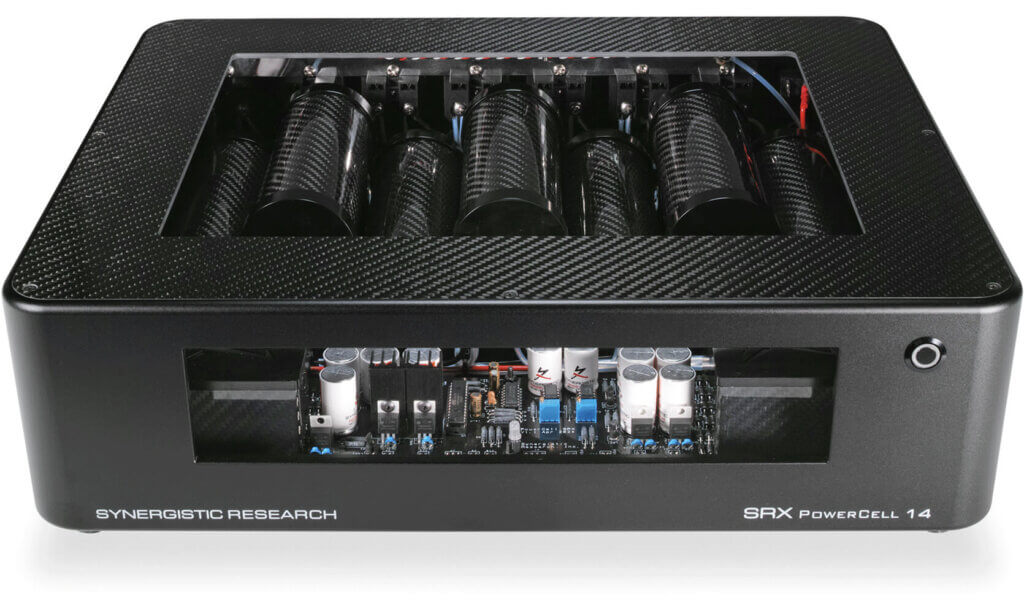
This is where the engineering gets interesting. Rather than filtering through series impedance, advanced power conditioning uses parallel electromagnetic structures: fields that influence the power without obstructing its flow. DC-biased plates that condition passing current without limiting it. Internal ground planes that establish reference stability. Energy storage that releases instantaneously during peaks.
The result is counterintuitive: a conditioner that can actually deliver more peak current than what comes from the wall. Stored energy in electromagnetic cells supplements wall capacity during transient demands, creating a reservoir that makes current available faster than the grid itself can supply it.
What Changes
When power is both conditioned and unrestricted, the effect isn’t additive. It’s revelatory. The noise floor drops, revealing low-level detail that was always there but buried. Transients arrive with their full leading edge intact. The soundstage gains depth and dimensionality because the subtle spatial cues aren’t being masked. The system sounds more effortless because it actually is. It’s no longer fighting contamination with every note.
The Cascade Effect
Power, unlike most system upgrades, affects everything simultaneously. A better interconnect improves the connection between two components. A better speaker improves transduction. But better power improves every component at once—source, preamp, amplifier, even digital devices with their own internal power supplies benefit from starting with cleaner AC.
This makes power one of the highest-leverage investments in any system. A single properly engineered power foundation can elevate performance across the entire chain in ways that would require multiple component upgrades to achieve otherwise.
I’ve watched this play out repeatedly in my room: a system that felt like it had reached its ceiling suddenly finds another level of resolution and dynamics. Not because anything changed in the signal path, but because everything in the signal path could finally do its job without fighting contamination.
Power and Grounding: Two Halves of One Foundation
If you’ve read my piece on why grounding matters, you’ll recognize a parallel. Power delivers the energy. Grounding provides the reference against which that energy is measured. Both enter your components directly, bypassing any chassis shielding. Both affect the noise floor more than most signal-path upgrades. Both are invisible foundations that determine how much of the music you actually hear.
Addressing one without the other leaves half the foundation incomplete. The most effective systems treat power and ground as interconnected: conditioned power synchronized to a stable ground reference, with both domains working together rather than in isolation.
The Complete Picture
Power sets the ceiling on dynamics and resolution. Grounding sets the floor for noise and reference stability. Together, they define the window through which you hear your music. Widen that window, and everything else in your system has more room to perform.
What I Heard in My Room
I should be clear about my own experience. When I first addressed power seriously in my reference system, I wasn’t expecting much. I’d been focused on the usual path of upgrading components. Power seemed like an afterthought, something that mattered more in theory than in practice.
I was wrong. The difference wasn’t subtle. Backgrounds became genuinely black in a way I’d assumed required more expensive electronics. Transients gained an immediacy that made familiar recordings feel newly present. And the sense of ease, the feeling that the system was coasting rather than straining, changed how long I wanted to listen.
That’s what converted me from skeptic to advocate. Not the theory, though the engineering makes sense. The listening.
If you’re curious what proper power conditioning might reveal in your system, let’s talk. I’m happy to share what’s worked in different contexts, from modest systems to reference-level setups.
Final Thought
There’s a category of upgrades that don’t add anything; they remove what was obscuring what you already have. Power conditioning, done right, belongs in that category. It doesn’t change the character of your components. It lets them be fully themselves.
The music was always there. The question is whether the power is letting you hear it.